

Founder & head coach
Jérémy De Vriendt
A former professional goalkeeper at Standard Liège, KV Mechelen and NEC Nijmegen. Today he passes on his passion through a method that has already produced professional goalkeepers.
“I hope people will describe me as someone caring, with strong human values, able to set a framework that is strict but fair.”
5 ans
at Standard Liège
4
gardiens devenus pros
30+
gardiens en pôles élite
22
en centres élite en 2022
Introduction
The man behind the academy.
Can you introduce yourself in a few words?
My name is Jérémy De Vriendt, born on 22 March 1986 in Namur. I am the founder and coach of the Aureak academy. Football, photography and art are my passions — those three shape my daily life….
Can you briefly describe your football career?
I came through elite academies and at 18 I turned professional at Standard Liège, where I played for five years. I then transferred to K.V Mechelen and afterwards NEC Nijmegen. Unfortunately a serious injury forced me out for two years. I made my comeback at White Star, then played mostly in the third division, before finishing my career with eight outstanding seasons at R.C.S Onhaye.
What are your best memories in football?
I was lucky enough to win the title several times. My first, with Standard Liège, is etched in my memory, as are the promotions with Solières and R.C.S Onhaye, and of course my last title with Onhaye.
Two high points of my career remain coming on against Sampdoria in the Europa League and my first top-flight match against Sporting Charleroi.
Did you think about becoming a goalkeeper coach while you were still playing?
I have always had that teaching streak. I like passing on what I have learned and finding the best way for my players to progress faster. As a child I was already training my best friend as a goalkeeper. Even as a professional, I remember working with Anthony Moris on coming out at players' feet after our sessions.
Were there goalkeeper coaches who left a mark on you along the way?
I have been extremely lucky throughout my career. My first goalkeeper coach was Mr Bodart at Sporting Charleroi: excellent at teaching technique and a genuinely kind man. Then came Mr Mathys, also at Sporting, who ran his sessions like nobody else.
At Standard Liège I had two youth coaches: Mr Lancellotti, extremely organised, and Mr Didier Piot, whose style was truly one of a kind. When I turned professional I had the good fortune to work with Mr Christian Piot, an extraordinary person of rare kindness, on the pitch and off it.
After that I had Mr Dardenne. During the years we were Belgian champions I was coached by Mr Veloso, whose sessions were always varied and enjoyable. My final year was under Mr Lecompte, who placed great importance on physical preparation and organised his sessions very well.
At KV Mechelen I had the pleasure of working with Mr Deville, who still checks in on me regularly. Then at White Star I had Mr … And finally, at La Louvière, the hugely charismatic Mr Dudas.
How would you describe yourself as a goalkeeper coach?
I try to draw on each of my coaches' qualities and make them my own. Another coach who marked me deeply is Mr Lukalu, an outfield coach who was very strict about human values and education, and to whom I owe a great deal.
I will never be able to thank football enough for making me grow — not only as an athlete, but above all as a man. I hope people will describe me as someone caring, with strong human values, and able to set a framework that is strict but fair.
Career path
From Standard Liège to the Aureak pitches.
Professional career
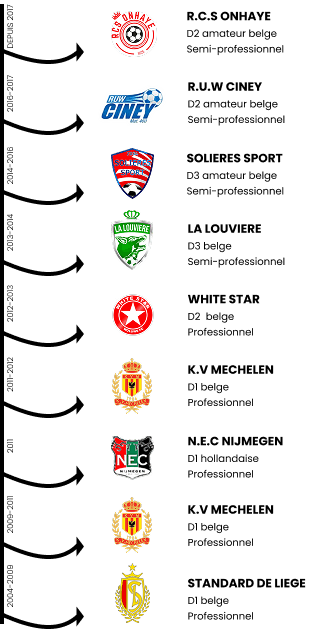
Youth career

Values & expertise
What football taught me, I pass on.
What do you see as the essential qualities in a young goalkeeper?
For me, the foundations in a young goalkeeper are these:
- Respect: a polite child, considerate towards those around him, who lights up the pitch. He is a pleasure to be around, for his teammates and for the coaches alike.
- Receptiveness: he listens to the instructions for the drills and pays attention to technical corrections. You can see he is making the effort to put into practice what is asked of him.
- A taste for hard work: a child who does not shy away from physical effort, and who does not try to cut corners to do less.
- Passion: a passionate child improves faster, is more resilient and keeps going over time.
Which skills should a goalkeeper acquire first?
I prefer to approach that question according to the goalkeeper's age and the situations he will mostly come up against.
- U08 – U09: play with the feet is fundamental in modern football. Beyond that, if the child plays a key role in the possession phases (8-a-side and up), they will take even more pleasure in playing in goal. This approach should be encouraged throughout their development.
- U10 – U13: the priority is speed and movement skills, followed by technique. The basic technical movements (shot stopping, one against one, coming out on crosses, dealing with balls in behind, distribution and so on) are easier to master when the child has good movement skills. The drills are there to wake the child up to what the sport demands. I like to let them discover the whole range of goalkeeping movements, so they can make connections between the different actions.
- U14 – U17: reading space, presence, and understanding the game alongside teammates become the priorities. The first years in a full-size goal can be hard. The larger spaces often lead to positioning errors. This is the moment to give goalkeepers clear reference points and to set rules. The aim is to help them understand game situations better, so that deciding becomes easier.
- U18 – U21: at this age the priority is technical quality, building reference points and improving decision-making. It is the period where you reinforce strengths and correct the last technical and tactical problems. Tactical work becomes essential in this phase.
- Senior: the emphasis is on performance and results. The work focuses on gathering information and making decisions, refining every detail in order to reach excellence on the pitch.
What are the selection criteria for joining the academy?
The most important criteria are respect, receptiveness, a willingness to work hard and a passion for sport. The rest is learned over time, and it is a genuine pleasure for me to watch children progress through their commitment and their work.
What are your objectives when you coach a young goalkeeper?
My main goal is to pass on my passion and my human values. I give the best of myself so that the child can go beyond their own expectations and keep progressing.
Results
Goalkeepers we developed who reached the highest level.
Is the elite pathway the sporting goal to aim for?
No. I am convinced it is entirely possible to flourish and improve outside the elite centres. Changing environment too early is not always the best option. I believe it is essential to put the child's wellbeing ahead of the sporting project. Every child is different, and it matters not to rush a decision like that. If you have doubts, do get in touch with the academy.
Even so, plenty of children do move on to the elite centres?
Yes, a good number of children have chosen to join elite programmes, and I am obviously very proud of that. In 2022, 22 goalkeepers I had worked with, whether in sessions or at camps, ended up in elite centres. Of course we are not solely responsible for their success, but knowing that we played a part.
How many children have gone through the elite centres?
I could not give an exact figure, but I would say between 30 and 40 goalkeepers have joined the elite centres. What makes me proudest is seeing those children progress and give the best of themselves.
Have you had goalkeepers who turned professional?
Yes, four goalkeepers I have worked with are currently under contract at professional clubs. Three of them are my nephews, which is a great source of pride.
Can you introduce the goalkeepers who turned professional?
Of course! There are:
- Noah, born in 2005, who plays for Standard Liège with the U23s.
- Théo, born in 2007, who trains with the OHL first team and also plays in the U23s.
- Ugo, born in 2008, who trains with the Sporting Charleroi first team. I hope he will play his first U23 matches soon.
There is a certain pride when you talk about them…
Absolutely! We all share the same passion, and we often talk about the steps they are taking. I also see all the sacrifices they make to chase their dreams. What makes me proudest is knowing they have a goal and are doing everything they can to reach it.
What advice would you give to young goalkeepers who want to play at a high level?
- Surround yourself well: the most important thing is to be well supported. Do not focus only on the name of the club, but on the coaching in your own age group. The environment should help you flourish, with a good team and good teammates.
- Come to an Aureak camp: to learn the basics, I recommend an Aureak camp. Afterwards, if there is an academy near you, join it to keep improving.
- Play a range of sports: do not limit yourself to football. Get outside, play other sports, and above all avoid spending too long in front of a screen. Take every chance to move and stay active.
- Set micro-objectives: to improve, break your objectives into small steps. If you lack speed, for instance, build in daily work such as skipping, core sessions or drills with a speed ladder.
- Keep a football diary: write down your sessions, what you did and what you learnt. It helps you keep track of your progress and stay focused on your objectives.
- Use the technology: as soon as you play in a full-size goal, film yourself. Watch your matches back, analyse your actions, and ask your coach for advice on improving. Technology is within everyone's reach, so use it to your advantage!
I will never be able to thank football enough for making me grow — not only as an athlete, but above all as a man.
Aureak Goalkeeper Academy